Cervical Posterior Fusion
Cervical posterior fusion is neck surgery that may stabilize the cervical spine when instability, deformity, or decompression requires support.

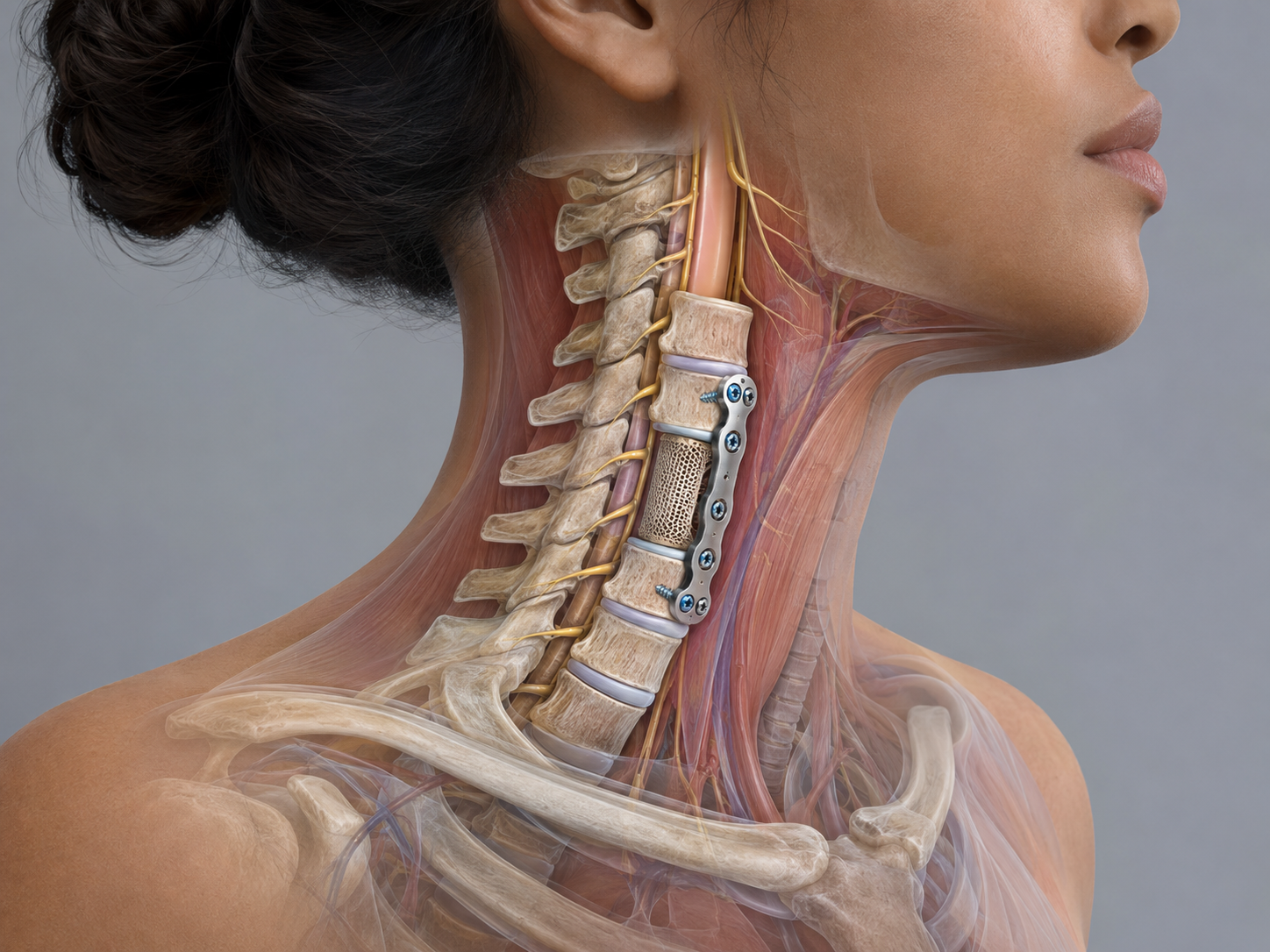
Corpectomy is spine surgery that removes part or all of a vertebral body. The vertebral body is the front, weight-bearing part of a spinal bone. Removing it can create space when the spinal cord or nerve roots are compressed by bone, disc material, tumor, fracture, infection, or severe deformity.
Corpectomy may be performed in the cervical spine, thoracic spine, or lumbar spine, depending on where the problem is located. In the neck, it is often called cervical corpectomy or anterior cervical corpectomy and fusion, sometimes shortened to ACCF.
Because removing part of a vertebral body can affect spinal support, corpectomy is commonly combined with reconstruction and fusion. De Novo Brain & Spine evaluates adult patients in Stockbridge, Fayetteville, Atlanta, and surrounding communities to help determine whether corpectomy, another surgical option, or non-surgical care may be appropriate.
Corpectomy may be considered when the main problem involves compression, collapse, disease, or structural damage affecting the vertebral body. It is not used for every patient with neck pain, back pain, arthritis, or a herniated disc.
Conditions that may lead to consideration of corpectomy include:
Corpectomy is usually considered for more complex structural problems. It is not a routine treatment for simple neck pain or low back pain.
Corpectomy may be considered when spinal cord or nerve compression cannot be adequately treated by removing only a disc, small bone spur, or part of the lamina. It may also be considered when the vertebral body itself is damaged, collapsed, infected, fractured, or involved by tumor.
In the cervical spine, corpectomy may be discussed when compression is coming from the front of the spinal canal and extends behind the vertebral body. Symptoms may include arm pain, numbness, tingling, weakness, hand clumsiness, balance difficulty, walking problems, or other signs of cervical myelopathy.
In the thoracic or lumbar spine, corpectomy may be considered when a fracture, tumor, infection, deformity, or severe collapse causes pressure on the spinal cord, cauda equina, or nerve roots. Some situations are urgent, especially when neurologic function is worsening.
The decision depends on whether the patient’s symptoms, examination findings, imaging, and overall medical condition point to a surgically treatable problem.
Doctors determine whether corpectomy may be appropriate by comparing the patient’s symptoms, neurologic examination, imaging findings, spinal alignment, stability, and overall health.
Evaluation may include:
Corpectomy is not chosen based on imaging alone. The imaging findings must match the patient’s symptoms and examination, and the expected benefit must be weighed against the risks and alternatives.
Corpectomy is performed through an approach chosen for the location of the problem. In the cervical spine, the approach is often from the front of the neck. In the thoracic or lumbar spine, the approach may be from the front, side, back, or a combined route depending on the anatomy and surgical goal.
The surgeon removes part or all of the affected vertebral body and any nearby disc, bone, tumor, fracture fragment, or tissue that is compressing the spinal cord or nerves. The goal is to create more space around the compressed neural structures.
After removal, the spine usually needs reconstruction. A cage, spacer, bone graft, plate, screws, rods, or other stabilization method may be used to support the spine and help the treated levels fuse over time. The exact plan depends on the diagnosis, spinal level, number of vertebrae involved, bone quality, alignment, stability, and surgeon judgment.
The main goals of corpectomy are to decompress the spinal cord or nerve roots, remove diseased or damaged vertebral body tissue when necessary, reconstruct spinal support, and stabilize the affected area.
Potential benefits may include reduced pressure on the spinal cord or nerves, improved spinal stability, support for alignment, and treatment of selected structural problems caused by tumor, fracture, infection, deformity, or severe degenerative disease. Improvement is not guaranteed, and neurologic recovery can vary.
Corpectomy has important limitations. It does not treat every cause of neck pain or back pain. It does not reverse all spinal cord or nerve injury. It reduces motion across fused levels. It may require a larger reconstruction than some other spine procedures.
General risks may include infection, bleeding, nerve injury, spinal cord injury, spinal fluid leak, persistent pain, hardware-related problems, failure of fusion, adjacent-level problems, alignment changes, or need for additional surgery. Depending on the approach, risks may also involve swallowing or voice changes, blood vessel injury, lung-related issues, abdominal or chest structures, or other nearby anatomy.
Treatment planning is individualized. Corpectomy is one option among several possible treatments for complex spine conditions.
Non-surgical options may include observation, medication, physical therapy, bracing, antibiotics for selected infections, pain management, image-guided injections, radiation, chemotherapy, or other multidisciplinary treatment depending on the diagnosis.
Other surgical options may include anterior cervical discectomy and fusion, cervical disc replacement, cervical laminectomy, laminoplasty, posterior cervical fusion, thoracic decompression, lumbar decompression, tumor biopsy, tumor resection, fracture stabilization, or other fusion procedures. When a vertebral tumor is part of the surgical concern, spinal tumor removal may also be reviewed as part of decompression, biopsy, or stabilization planning.
These treatments are not interchangeable. The best option depends on the location of compression, cause of the problem, number of levels involved, spinal alignment, instability, neurologic findings, tumor or infection status, bone quality, medical risks, and patient goals.
Recovery after corpectomy varies from person to person. It depends on the reason for surgery, the spinal level treated, the number of levels involved, whether fusion is performed, the patient’s neurologic status before surgery, and overall health.
Follow-up usually focuses on incision healing, pain control, neurologic function, swallowing or voice symptoms when the neck is treated from the front, walking and balance, activity restrictions, medication use, and imaging to monitor reconstruction, hardware position, alignment, and fusion healing.
Some patients may need physical therapy, rehabilitation, bracing, oncology care, infectious disease care, or additional treatment depending on the underlying diagnosis. Fusion healing takes time, and patients should follow the surgeon’s instructions about activity, lifting, bending, twisting, nicotine avoidance, medication use, and follow-up imaging.
Seek emergency medical care or call 911 for new or worsening weakness, difficulty walking, loss of balance, loss of bowel or bladder control, numbness in the groin or saddle area, or rapidly worsening numbness.
Urgent evaluation is also important for severe neck or back pain after trauma, fever with severe spine pain, new hand clumsiness, worsening coordination, severe pain with a history of cancer, or sudden neurologic decline.
Patients with persistent neck pain, back pain, arm or leg pain, numbness, tingling, weakness, walking problems, or coordination changes should seek medical evaluation, especially when symptoms interfere with daily function or continue despite conservative care.
Corpectomy may be used to remove part or all of a vertebral body when it is compressing the spinal cord or nerves, or when it is damaged by tumor, fracture, infection, collapse, or severe degenerative disease.
No. Discectomy removes disc material. Corpectomy removes part or all of a vertebral body and often the nearby discs as well. Corpectomy is usually considered when decompression requires more than disc removal alone.
Corpectomy is commonly combined with reconstruction and fusion because removing part of the vertebral body can affect spinal support. The exact reconstruction depends on the diagnosis, spinal level, number of levels treated, alignment, and bone quality.
No. Corpectomy can be performed in the cervical, thoracic, or lumbar spine when clinically appropriate. Cervical corpectomy is commonly discussed for spinal cord compression in the neck, but thoracic or lumbar corpectomy may be considered for selected tumors, fractures, infections, or deformity.
Seek urgent medical care for new or worsening weakness, trouble walking, loss of bowel or bladder control, numbness in the groin or saddle area, severe spine pain after trauma, fever with severe spine pain, or rapidly worsening neurologic symptoms.
Schedule a Consultation
Learn if this procedure is right for you.
Cervical posterior fusion is neck surgery that may stabilize the cervical spine when instability, deformity, or decompression requires support.
Spinal tumor removal is spine surgery that may remove, biopsy, decompress, or stabilize selected tumors affecting the spinal column or nerves.
Anterior cervical discectomy and fusion (ACDF) is neck surgery that may relieve cervical nerve or spinal cord pressure in selected patients.