
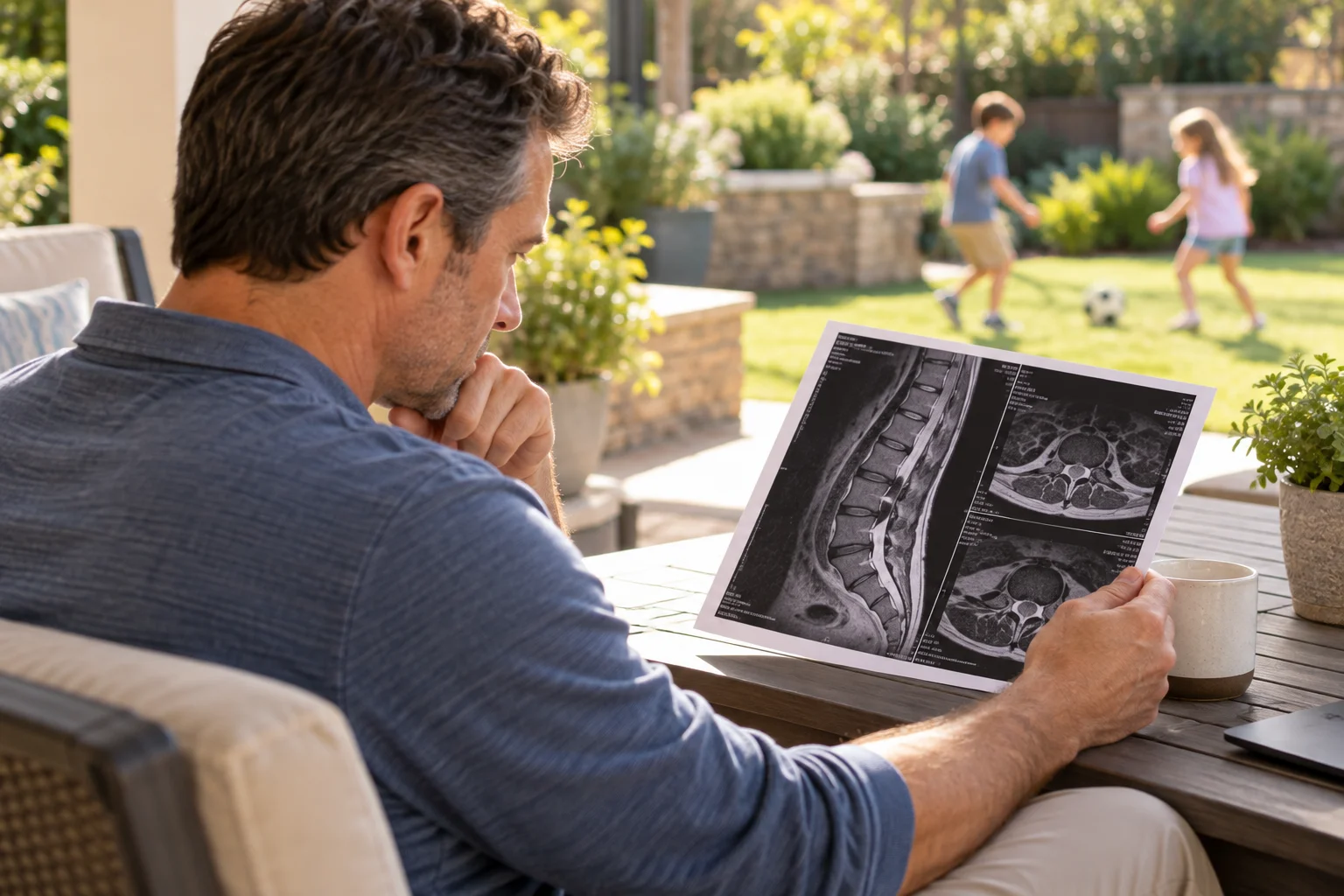
A spinal cyst on an MRI does not automatically mean you need surgery. An operation may help when a cyst causes lasting pain that limits daily life or puts nerve or spinal-cord function at risk. New or worsening weakness can require faster care, without a long trial of therapy or injections. The cyst type, symptoms, exam, and expected benefits and risks guide the choice.
Start With the Type of Cyst
“Spinal cyst” describes several conditions, not one diagnosis. A cyst is a fluid-filled sac. Where it forms changes which problems it might cause and how it is treated.
Synovial cysts form near the facet joints, small joints at the back of the spine. They often develop with age-related joint changes and are most common in the lower back. A cyst may press on a nerve root and cause leg pain, numbness, or weakness. Related joint cysts may be called ganglion or juxtafacet cysts.
Tarlov cysts, also called perineural cysts, form along nerve-root coverings, often in the sacrum at the base of the spine. Many cause no symptoms. Others may cause pelvic or leg pain, changes in feeling, or problems with bladder, bowel, or sexual function. Nerve fibers can run within the cyst wall. This makes treatment more complex.
Spinal arachnoid cysts contain cerebrospinal fluid, the fluid around the brain and spinal cord. They involve the thin membranes around the cord. They may lie inside or outside its tough outer covering. Some press on the cord or disrupt fluid flow. They are not treated the same way as facet-joint cysts.
Does the Cyst Explain Your Symptoms?
The visit starts with your health history and an exam of how your nerves are working. A clinician checks strength, feeling, reflexes, and walking or balance. These findings are compared with the scan. The cyst should fit the side and pattern of your symptoms before it is treated as their cause.
A lower-back facet cyst may contribute to spinal stenosis, or narrowing around the nerves. Leg pain that worsens with standing or walking may fit that pattern. But a disc problem, arthritis, or a problem outside the spine can cause similar pain. Pain that lasts or fails to improve with rest does not prove that a cyst is the cause. When a cyst does not explain the pain, the symptoms still deserve care and a search for other causes.
MRI shows where the cyst is and how it relates to the nerves, spinal cord, and nearby tissues. More tests may help if the diagnosis or treatment plan is unclear. In some cases, contrast material is used during MRI to help tell different types of findings apart. Not everyone needs more scans.
Size matters, but no single measurement means that every spinal cyst needs surgery. Its effect on nearby tissues, changes over time, and exam findings all count.
When Observation or Nonsurgical Care Makes Sense
A cyst found by chance may need no active treatment. This is most likely when it does not match any symptoms and is not causing concern on the exam or scan. Your clinician decides whether follow-up exams or scans would help. There is no one scanning schedule for all cysts. Ask which changes you should report.
For a lumbar facet cyst causing symptoms but no worsening nerve function, care may include changes to daily tasks, physical therapy, and medicine chosen for your health needs. An injection near an irritated nerve may ease pain and inflammation. It does not necessarily remove the cyst.
In some cases, a clinician may use imaging to guide a needle procedure to drain or rupture a lumbar facet cyst. Relief may not last. The cyst can refill, or symptoms can return. This is an option for some patients, not a required step before surgery. It is not suitable for every type of cyst.
Tarlov cysts need a separate assessment. Targeted procedures or surgery may help some patients. The plan must account for nerve fibers and connections to spinal-fluid spaces. A specialist with experience treating these cysts can explain the choices and risks.
When Surgery May Be Recommended
Lasting symptoms linked to the cyst
Surgery may be an option when a lumbar facet cyst causes lasting leg pain or walking problems that limit daily life. This often follows a trial of suitable nonsurgical care. The exam and scan should support the cyst as the cause. The goal is to free the affected nerves from pressure, not simply remove a finding on the scan.
The surgeon also weighs your health, goals, and other spinal problems. One injection that did not help is not, by itself, a reason for surgery.
Worsening nerve or spinal-cord function
Worsening weakness, walking problems, or loss of spinal-cord function can change the timing. These findings need prompt care. Surgery may be needed before trying other treatments. Sudden or rapidly worsening loss of function requires emergency care.
For example, an arachnoid cyst pressing on the cord and causing worsening nerve function needs a surgical assessment. Repeated injections are not a substitute. Surgery may open or remove part of the cyst to relieve pressure and restore fluid flow. Removing the whole cyst is not always safest if it is attached to the cord or nerves.
Surgery may help, but it cannot promise full pain relief or nerve recovery. Ask about risks for the planned operation. These may include infection, spinal-fluid leakage, nerve injury, symptoms that remain, or a cyst that returns.
Does Cyst Removal Always Require Fusion?
No. For a lumbar facet cyst, decompression makes room around the nerves. It usually involves removing the cyst and other tissue causing pressure. Fusion joins spinal bones to help keep that part of the spine stable. They serve different purposes.
Decompression alone may be enough when that part of the spine is stable. Fusion may be considered if there is spinal instability, or if removing bone and joint tissue would make it unstable. Having a cyst does not, on its own, mean you need fusion.
A smaller-incision approach may suit some patients, but not every cyst. The surgeon needs enough access to treat the problem while protecting the nerves and other tissues.
Warning Signs That Should Not Wait
Go to the emergency room immediately for:
- New trouble starting urination, inability to urinate, loss of the normal urge to urinate, or new loss of bladder control
- New loss of bowel control
- New numbness around the genitals, anus, buttocks, or inner thighs, the saddle area
- Sudden or rapidly worsening weakness, paralysis, or inability to walk
- Severe neck or back pain after a major injury, especially with numbness or weakness.
These symptoms can signal cauda equina syndrome (a serious problem affecting nerves below the spinal cord), spinal-cord compression, or another emergency. They do not have to occur together. Do not assume a previously diagnosed cyst explains a new symptom. Call 911 for sudden or severe symptoms or when you cannot travel safely. De Novo Brain & Spine is an outpatient practice and does not provide emergency care.
Seek prompt care for new foot drop, trouble lifting the front of the foot, or steadily worsening numbness, weakness, balance, or hand use. Back pain with fever, unexplained weight loss, or a cancer history also needs timely assessment. Depending on how severe symptoms are and how fast they change, emergency care may be needed.
Frequently Asked Questions About Spinal Cysts
Can spinal cysts affect daily activities?
Some spinal cysts may be associated with symptoms that interfere with everyday activities, while others cause no noticeable problems. The impact depends on the cyst’s location, surrounding structures, and individual circumstances. A healthcare professional can help determine whether reported symptoms are related to the cyst.
How are spinal cysts monitored over time?
Monitoring may involve follow-up appointments, physical examinations, and imaging studies when appropriate. The frequency of monitoring depends on individual symptoms, clinical findings, and the healthcare provider’s recommendations. Not every spinal cyst requires repeated imaging.
What should patients discuss with their doctor after a spinal cyst diagnosis?
Patients can ask about the type and location of the cyst, whether it may explain their symptoms, and what follow-up care is appropriate. Discussing changes in symptoms, daily activities, and available treatment options can help patients better understand their condition.
Can lifestyle habits support overall spine health?
Maintaining appropriate physical activity, practicing comfortable posture habits, and following individualized healthcare recommendations may support general spine health. However, lifestyle changes do not necessarily shrink or eliminate spinal cysts. Patients should discuss suitable activities with their healthcare provider.
When should patients seek another medical opinion about a spinal cyst?
A second opinion may be helpful when patients have questions about their diagnosis, treatment recommendations, or available options. Another qualified specialist can review relevant medical records and imaging findings to provide additional perspective on the condition.
Preparing for a Spine Consultation
Bring the imaging report and arrange access to the actual images. Note when symptoms started, what has changed, how walking or daily tasks are affected, and which treatments have helped. Ask: “What type of cyst is this?” “Which findings connect it to my symptoms?” and “What would change the treatment plan?”
Dr. Larry R. Shannon II, MD, FAANS, is a board-certified neurosurgeon at De Novo Brain & Spine, a surgeon-led practice in Stockbridge serving South Metro Atlanta. A visit or second opinion can help clarify whether you need follow-up, more testing, nonsurgical care, or a surgical discussion. Call (404) 882-3592 or request an appointment online.
Educational Note: This article provides general education and does not replace individual medical evaluation or treatment. For a medical emergency, call 911 or go to the nearest emergency room.