
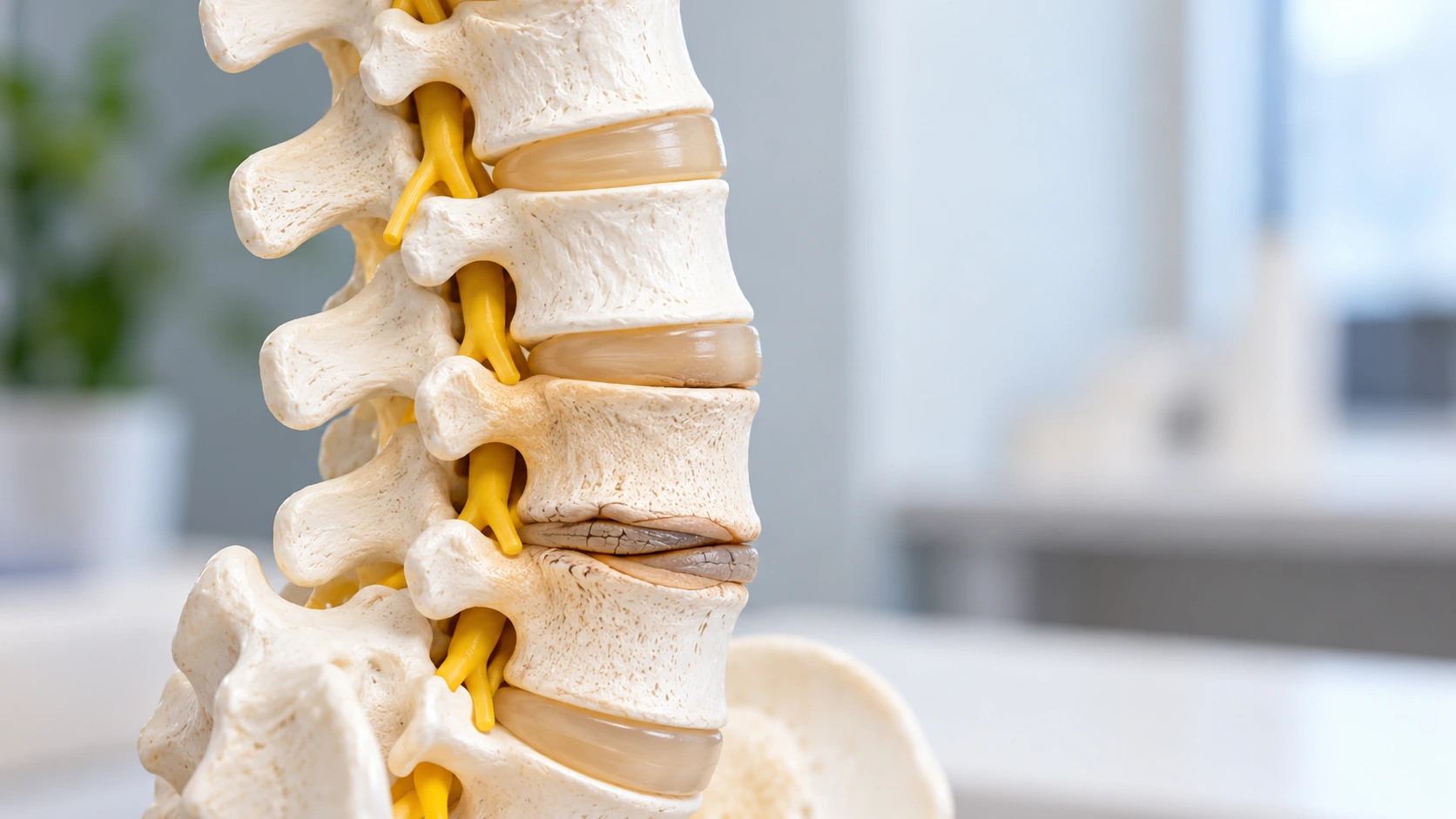
“Degenerative disc disease” on an MRI often describes changes that become more common with age. It does not, by itself, prove that a disc is causing pain or that treatment is needed. What matters is how the scan fits your symptoms and exam. Ongoing pain deserves attention. New weakness or bladder problems can change how quickly you need care.
What Degenerative Disc Disease Really Means
The discs between your spinal bones, called vertebrae, act like cushions. They help absorb shock and let your spine bend and twist. Over time, discs may lose water and height, become stiffer, or develop changes in their outer layer.
Doctors use degenerative disc disease to describe these changes, sometimes in the context of neck or back pain. The term alone does not tell you whether a disc is painful, a nerve is affected, or surgery would help.
Disc degeneration is also not the same as a herniated disc. With a herniation, some disc material extends beyond the disc’s normal edge. The two can occur together, but they are not the same finding.
Why an Abnormal-Looking Disc May Not Be the Problem
A review of studies involving more than 3,000 people without symptoms found disc degeneration even in young adults. It became much more common with age. This helps explain why a worn disc on a scan does not always reveal the source of pain.
That does not make every finding unimportant. It means the MRI must be considered with the person’s health and exam. A disc can look worn without causing trouble. Pain can also limit daily life without one clear cause on a scan.
Neither “it is just aging” nor “the MRI looks abnormal” is enough to explain what should happen next. The useful question is whether the finding helps explain your particular problem.
When Do Disc Changes Matter?
Pain centered in the neck or back
A disc can contribute to pain without pressing on a nerve. This is sometimes called discogenic pain. Muscles, joints, and other tissues can cause similar pain. Pain with sitting, bending, or lifting does not prove that a disc is the source.
Pain that disrupts sleep, work, or daily tasks deserves care, even without numbness or weakness. How the pain changes and responds to treatment matters. Morning stiffness alone cannot tell you that disc aging is the cause or that nothing else needs attention.
Pain or loss of nerve function
Nerve roots connect the spinal cord with nerves that travel into the body. Loss of disc height, a herniation, or nearby bone changes can reduce the space around a spinal nerve root. When a root is irritated or compressed, pain may travel into an arm or leg. Tingling or numbness may also occur.
Pain that travels and loss of nerve function are related but different. A clinician checks strength, feeling, and reflexes to see how the nerve is working. Severe pain does not always mean severe nerve damage. Significant weakness can occur with little pain. A finding must also fit the side and path of the symptoms. An unrelated disc change should not become the assumed cause.
Changes involving the spinal cord
In the neck, degenerative changes can narrow the space around the spinal cord. Trouble with buttons or handwriting, dropping objects, balance changes, or difficulty walking may suggest a different problem from an irritated nerve root.
These changes need prompt medical care. Sudden or rapidly worsening weakness requires emergency care, not a routine office visit.
How a Spine Specialist Reviews the Findings
The visit starts with your history and a physical exam. A clinician asks where symptoms began, whether pain travels, and which daily tasks are harder. Changes in strength or coordination, past injuries, other health problems, and prior treatments also matter.
The images are then checked for findings that match the affected side, spinal level, and exam. Reviewing the actual images, not only the written report, helps the clinician assess that match.
More imaging is not automatic. For new low-back pain without warning signs, treatment and follow-up often come before a scan. Further tests may help when a serious cause is suspected. They may also help when ongoing symptoms and exam findings raise a question that would change care. Neck symptoms, spinal-cord concerns, and worsening weakness can require a different approach. There is no single waiting period for everyone.
Treatment Should Address the Problem, Not the MRI Label
A disc finding unrelated to your symptoms may need no treatment of its own. When symptoms are present, the goal is to improve comfort, movement, and daily life. Changes in nerve function also need to be tracked when relevant.
For symptoms without warning signs, care may include physical therapy, an exercise plan suited to your needs, and changes to tasks that worsen pain. Long periods of bed rest are generally not helpful. Medicine choices depend on your health, other medicines, and possible side effects.
Pain and function can improve even when disc changes remain visible on imaging. Progress is judged by symptoms, daily tasks, and exam findings, rather than by whether the MRI looks normal.
An epidural steroid injection places anti-inflammatory medicine near the spinal nerves. This targeted treatment may offer short-term relief for some people with nerve-root pain. It is not routine care for a worn disc seen on MRI. It does not rebuild the disc or remove the tissue pressing on a nerve.
Surgery requires a clear problem that an operation can reasonably address. Examples include nerve or spinal-cord compression that affects function, an unstable part of the spine, or selected cases of lasting, disabling pain. The findings, likely benefits, risks, and response to other care all matter. Significant or worsening loss of nerve function may require faster action rather than months of further treatment.
Even when surgery is appropriate, relieving nerve pressure and fusing spinal bones are separate decisions. Disc degeneration alone does not mean fusion is needed. Seeing a neurosurgeon does not mean an operation will be recommended.
Warning Signs That Should Not Wait
Go to the emergency room immediately for:
New trouble starting urination, inability to urinate, loss of the normal urge to urinate, or loss of bladder control
New loss of bowel control
New numbness around the genitals, between the legs, or in the saddle area of the buttocks and inner thighs
Sudden or rapidly worsening weakness or paralysis in an arm or leg
Severe neck or back pain after a significant injury, especially with weakness, numbness, or trouble walking
Bladder or bowel changes and saddle-area numbness can signal cauda equina syndrome, a serious problem involving the nerves below the spinal cord. Warning signs do not have to occur together or affect both sides. Call 911 for sudden or severe symptoms or when you cannot travel safely.
Seek same-day medical advice for new foot drop (trouble lifting the front of the foot), worsening hand coordination, spreading numbness, or gradually increasing weakness. New or worsening spinal pain with fever, unexplained weight loss, a cancer history, or an injury in someone with osteoporosis or long-term steroid use also needs timely assessment. These findings sometimes need emergency care. The right setting depends on how severe symptoms are and how quickly they change. Go to the emergency room for serious worsening or when urgent assessment cannot be arranged.
De Novo Brain & Spine is an outpatient practice and does not provide emergency care.
Making the Report Useful at Your Next Visit
Bring the imaging report and arrange access to the images. Note what has changed in your pain, walking, hand use, sleep, or daily activities, along with treatments already tried.
Useful questions include: “Which findings fit my symptoms?” “What are we trying to improve with treatment?” and “Which changes should make me seek care sooner?” These questions help turn an MRI label into a plan based on your needs.
Dr. Larry R. Shannon II, MD, FAANS, is a board-certified neurosurgeon at De Novo Brain & Spine, a surgeon-led practice in Stockbridge serving South Metro Atlanta. For ongoing symptoms or a second opinion about a proposed treatment plan, call (404) 882-3592 or request an appointment online.
Educational Note: This article provides general education and does not replace individual medical evaluation or treatment. For a medical emergency, call 911 or go to the nearest emergency room.