Minimally Invasive Spine Surgery
Minimally invasive spine surgery uses smaller surgical corridors to treat selected spine problems while limiting disruption to nearby muscles and tissues.

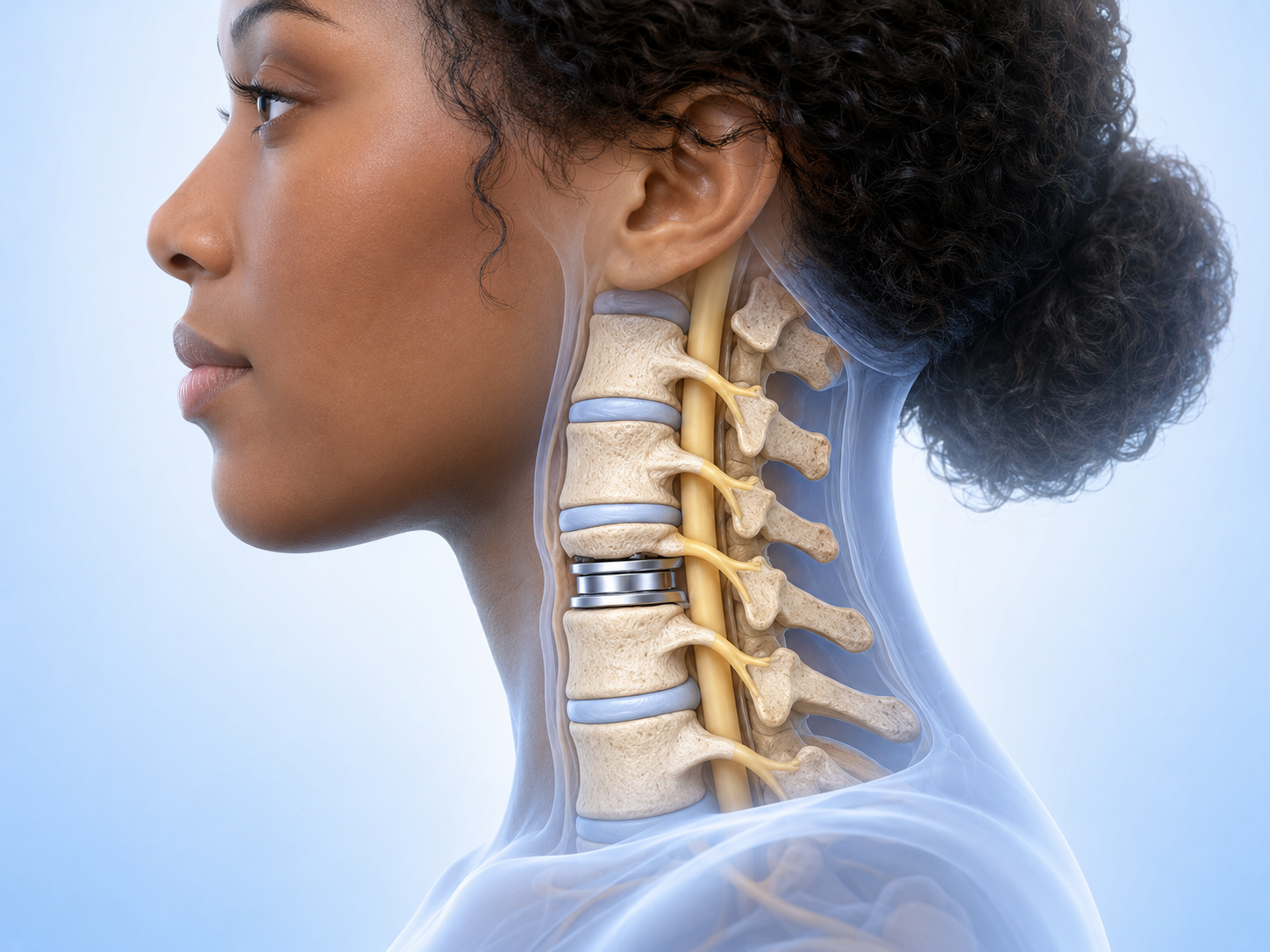
Cervical disc replacement is a neck surgery that removes a damaged cervical disc and replaces it with an artificial disc. The cervical spine is the part of the spine in the neck. The disc is the cushion between two vertebrae.
This procedure is also called cervical artificial disc replacement, cervical disc arthroplasty, or CDR. Unlike anterior cervical discectomy and fusion, or ACDF, cervical disc replacement is designed to preserve motion at the treated spinal level rather than fuse the bones together.
Cervical disc replacement may be considered when a damaged disc, disc herniation, or bone spur is pressing on a nerve root or the spinal cord. De Novo Brain & Spine evaluates adult patients in Stockbridge, Fayetteville, Atlanta, and surrounding communities to help determine whether cervical disc replacement, ACDF, another surgical option, or non-surgical care may be appropriate.
Cervical disc replacement is not the right treatment for every patient with neck pain or every patient with a disc problem. It may be considered when symptoms, examination findings, and imaging studies point to a treatable problem at one or more cervical disc levels.
Conditions that may lead to consideration of cervical disc replacement include:
Cervical disc replacement is generally not used when the main problem is severe spinal instability, severe facet joint arthritis, major deformity, severe osteoporosis, infection, tumor, fracture, or a condition that requires fusion for stability.
Cervical disc replacement may be considered when a cervical disc or bone spur is pressing on a nerve root and causing arm pain, numbness, tingling, or weakness. These symptoms are often called cervical radiculopathy.
It may also be considered in selected patients with spinal cord compression when the compression is coming from the front of the neck and the patient’s anatomy is appropriate for disc replacement.
In many non-urgent cases, patients first try non-surgical care. This may include medication, activity changes, physical therapy, home exercise, or injections when appropriate. Surgery may be discussed when symptoms continue, worsen, or return despite appropriate treatment.
Cervical disc replacement may be discussed instead of ACDF when the affected level can be decompressed and reconstructed while preserving motion. The decision depends on the diagnosis, spinal alignment, degree of arthritis, stability, bone quality, number of levels involved, and overall surgical goals.
Doctors determine whether cervical disc replacement may be appropriate by comparing the patient’s symptoms, neurologic examination, imaging findings, prior treatments, and overall health.
Evaluation may include:
The imaging must match the symptoms. A disc bulge or degenerative change on MRI does not automatically mean that cervical disc replacement is needed.
Cervical disc replacement is usually performed through an approach from the front of the neck. The surgeon removes the damaged disc and relieves pressure on the nerve root or spinal cord.
After the disc is removed, an artificial disc is placed into the disc space. The artificial disc is intended to maintain spacing between the vertebrae and allow some motion at the treated level.
The exact implant, surgical plan, and number of levels treated depend on the patient’s anatomy, diagnosis, imaging findings, and surgeon judgment. Cervical disc replacement is not performed the same way for every patient.
The main goals of cervical disc replacement are to relieve pressure on a cervical nerve root or the spinal cord, maintain disc space height, and preserve motion at the treated level when appropriate.
Potential benefits may include improvement in arm pain, numbness, tingling, or weakness related to nerve compression. In selected cases, the procedure may also help address symptoms related to spinal cord compression. Improvement is not guaranteed, and nerve or spinal cord recovery can vary.
Cervical disc replacement has important limitations. It does not treat every cause of neck pain. It does not reverse all nerve or spinal cord injury. It may not be appropriate when there is severe arthritis, instability, deformity, poor bone quality, infection, tumor, fracture, or other conditions that make motion preservation unsafe or less useful.
General surgical risks may include infection, bleeding, swallowing difficulty, voice changes, nerve injury, spinal cord injury, persistent symptoms, implant movement, device wear, abnormal bone formation around the disc, or the need for additional surgery. In some cases, a future fusion or revision procedure may be needed.
Treatment planning is individualized. Cervical disc replacement is one option among several possible treatments for cervical spine problems.
Non-surgical options may include observation, activity modification, medication, physical therapy, home exercise, and image-guided injections when appropriate.
Other surgical options may include ACDF, posterior cervical foraminotomy, cervical laminectomy, laminoplasty, posterior cervical fusion, or cervical corpectomy in selected cases. These procedures are not interchangeable.
The best option depends on the location of compression, number of levels involved, spinal alignment, instability, arthritis, bone quality, neurologic findings, medical risks, and patient goals. Cervical disc replacement may be appropriate for some patients, but it is not automatically better than fusion or another surgical approach.
Recovery after cervical disc replacement varies from person to person. It depends on the reason for surgery, the number of levels treated, the patient’s neurologic status before surgery, overall health, and the surgical plan.
Follow-up usually focuses on incision healing, swallowing or voice symptoms, pain control, neurologic function, activity progression, and imaging to evaluate implant position and spinal alignment. Some patients may need physical therapy or guided rehabilitation as recovery continues.
Symptoms caused by nerve or spinal cord compression may improve at different rates. Some symptoms may persist if the nerve or spinal cord was significantly irritated or injured before treatment.
Seek emergency medical care or call 911 for sudden or worsening weakness, difficulty walking, loss of balance, loss of bowel or bladder control, or rapidly worsening numbness.
Urgent evaluation is also important for severe neck pain after trauma, fever with severe neck pain, new hand clumsiness, worsening coordination, or symptoms that suggest spinal cord compression.
Patients with persistent neck pain, arm pain, numbness, tingling, or weakness should seek medical evaluation, especially when symptoms interfere with daily function or continue despite conservative care.
Cervical disc replacement may be used to treat selected patients with cervical disc disease that is pressing on a nerve root or the spinal cord. It is most often considered for cervical radiculopathy and selected cases of cervical myelopathy or myeloradiculopathy.
No. Cervical disc replacement removes the damaged disc and places an artificial disc designed to preserve motion. ACDF removes the damaged disc and fuses the treated spinal level so the bones heal together.
No. Cervical disc replacement and cervical fusion are different procedures used for different clinical situations. Disc replacement may be appropriate for some patients, while fusion may be better for patients with instability, severe arthritis, deformity, poor bone quality, or other structural concerns.
Doctors review symptoms, neurologic examination findings, MRI, X-rays, spinal alignment, motion at the affected level, bone quality, arthritis, prior surgery, and overall health. The decision depends on whether the patient’s anatomy and diagnosis are appropriate for motion preservation.
Seek urgent medical care for new or worsening weakness, trouble walking, loss of balance, loss of bowel or bladder control, severe neck pain after trauma, or rapidly worsening numbness. These symptoms may suggest spinal cord or nerve involvement.
Schedule a Consultation
Learn if this procedure is right for you.
Minimally invasive spine surgery uses smaller surgical corridors to treat selected spine problems while limiting disruption to nearby muscles and tissues.
Lumbar disc replacement is lower-back surgery that may replace a damaged disc while preserving motion in carefully selected patients.
Microdiscectomy is spine surgery that removes selected herniated disc material pressing on a nerve root, often causing sciatica.