Robotic Assisted Spine Surgery
Robotic assisted spine surgery uses planning and guidance technology to support selected spine procedures, especially when instrumentation is needed.

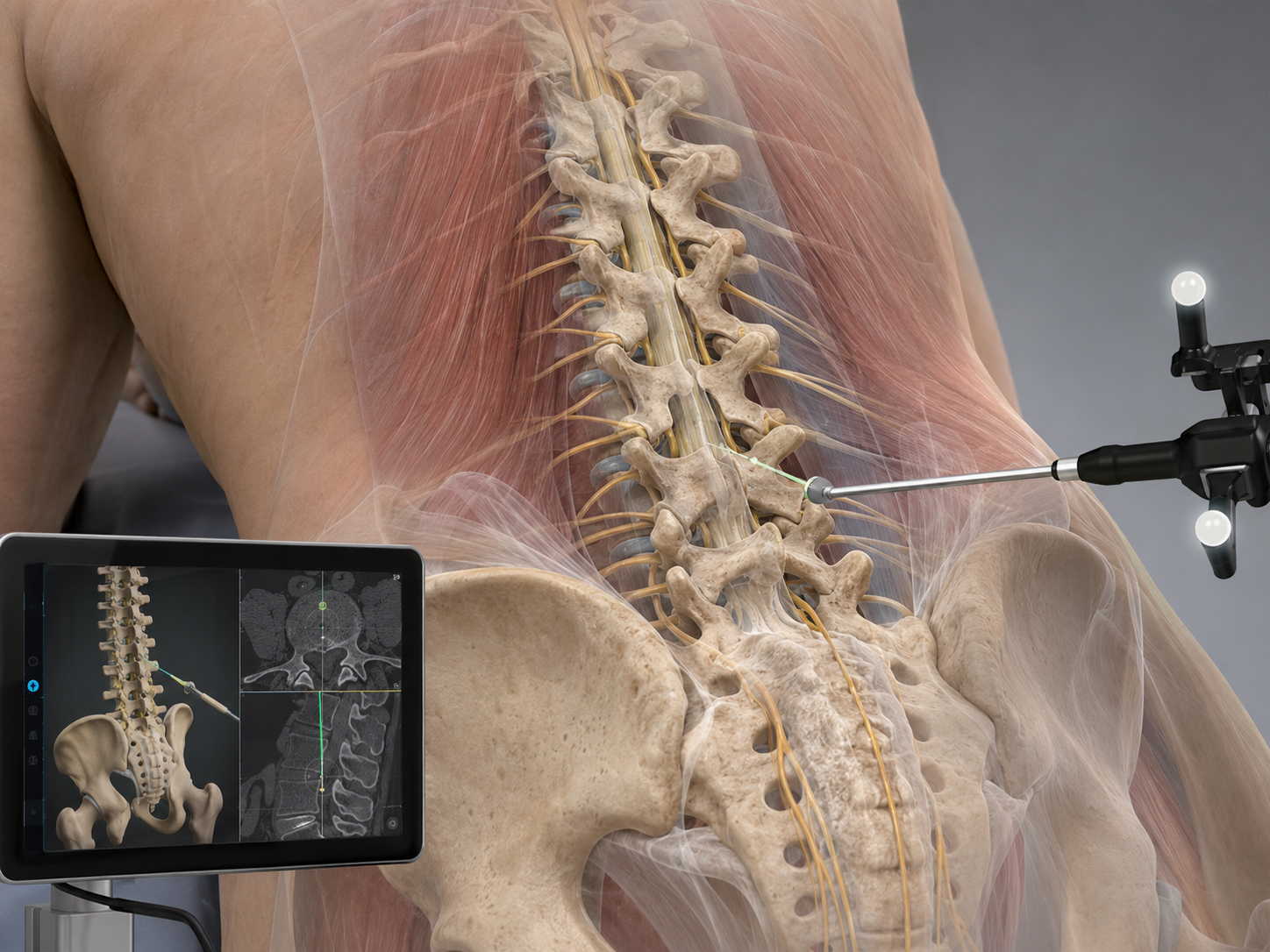
Computer assisted navigation is a surgical guidance technology that helps the surgeon understand where instruments are in relation to the patient’s anatomy during selected procedures. It is sometimes called computer-assisted surgical navigation, image-guided surgery, neuronavigation, or spinal navigation.
The technology usually uses CT, MRI, X-ray, fluoroscopy, or intraoperative imaging to create a map of the patient’s anatomy. During surgery, tracking tools help the surgeon compare the real-time position of instruments with that image-based map.
Computer assisted navigation is not a treatment by itself. It is a tool that may support surgical planning, localization, and instrument placement during certain brain or spine operations. De Novo Brain & Spine evaluates adult patients in Stockbridge, Fayetteville, Atlanta, and surrounding communities to determine which treatment approach may be appropriate based on the diagnosis, anatomy, imaging findings, and surgical goals.
Computer assisted navigation does not treat a condition on its own. It may be used as part of selected procedures where detailed anatomical localization is important.
Clinical situations where navigation may be considered include:
For selected bleeding emergencies or complex brain cases, craniotomy for hematoma evacuation may also require careful image review and surgical localization. The decision to use navigation depends on the procedure, the patient’s anatomy, the surgical setting, and the surgeon’s judgment.
Computer assisted navigation may be considered when the surgeon needs additional image-based guidance during a brain or spine procedure. It can be especially useful when anatomy is complex, narrow, shifted, distorted, or difficult to judge using direct vision alone.
In spine surgery, navigation may be considered when screws, rods, cages, or other instrumentation must be placed near important structures such as the spinal cord, nerve roots, or blood vessels. It may also help in minimally invasive spine surgery, where the surgeon works through smaller exposures and has less direct view of the anatomy.
In brain surgery, navigation may be considered when the surgeon needs to localize a tumor, lesion, biopsy target, or surgical pathway using preoperative or intraoperative imaging. It can help plan an approach that accounts for nearby brain structures, but it does not eliminate surgical risk.
Computer assisted navigation is used only when it adds value to the surgical plan. Some procedures can be performed safely without it.
Doctors determine whether computer assisted navigation may be appropriate by reviewing the diagnosis, anatomy, imaging findings, surgical goals, and technical needs of the procedure.
Evaluation may include:
Navigation is not selected because it sounds more advanced. It is selected when it may help the surgeon safely understand anatomy, plan a route, localize a target, or guide instrumentation.
Computer assisted navigation usually begins with imaging. The imaging may be obtained before surgery or during surgery, depending on the system and the procedure.
The navigation system then links the patient’s anatomy to the image-based map. This process is sometimes called registration. Once registration is complete, tracked instruments can be displayed on the navigation screen in relation to the patient’s anatomy.
In spine surgery, navigation may help guide the placement of screws or other implants. In brain surgery, navigation may help localize a lesion, plan a surgical corridor, or guide the surgeon toward a target area.
The surgeon remains responsible for the operation. Computer assisted navigation is a guidance tool, not an automatic surgical system and not a substitute for surgical judgment.
The goal of computer assisted navigation is to improve anatomical orientation during selected surgical procedures. It may help the surgeon plan, localize, and guide parts of the operation using image-based information.
Potential benefits may include improved visualization of anatomy, assistance with instrument placement, support for complex surgical planning, and help navigating distorted or difficult anatomy. These benefits depend on the procedure, the quality of imaging, the accuracy of registration, and the surgeon’s use of the system.
Computer assisted navigation has important limitations. It does not treat disease by itself. It does not guarantee better outcomes, eliminate complications, or make surgery risk-free. It does not replace the surgeon’s knowledge of anatomy or intraoperative judgment.
Navigation accuracy can be affected by patient movement, registration error, image quality, equipment limitations, changes in anatomy during surgery, and technical issues. If the navigation information does not match the patient’s anatomy, the surgeon must recognize that and adjust the plan.
Treatment planning depends on the actual diagnosis. Computer assisted navigation is not an alternative to surgery or conservative care; it is a technique that may be used during certain procedures.
Depending on the condition, treatment options may include observation, medication, physical therapy, injections, decompression, fusion, tumor biopsy, tumor resection, radiation, chemotherapy, rehabilitation, or other forms of multidisciplinary care.
For some surgeries, standard anatomical landmarks and conventional imaging may be sufficient. For other procedures, navigation, robotic assistance, intraoperative imaging, microscope guidance, endoscopy, or other technologies may be considered.
These tools are not interchangeable. The best approach depends on the patient’s diagnosis, anatomy, risk factors, available imaging, surgical goals, and the surgeon’s judgment.
Recovery after a procedure using computer assisted navigation depends on the actual surgery performed, not on the navigation system alone.
For example, recovery after a navigated spinal fusion is different from recovery after a navigated brain biopsy or tumor resection. Follow-up may include wound checks, neurologic examination, imaging, medication review, rehabilitation planning, or additional treatment depending on the diagnosis.
Patients should follow the recovery instructions for the specific procedure they had. Navigation may assist the surgery, but it does not determine the entire recovery process.
Urgent symptoms depend on the underlying brain or spine condition.
For spine symptoms, seek emergency medical care or call 911 for new or worsening weakness, loss of bowel or bladder control, numbness in the groin or saddle area, difficulty walking, severe pain after trauma, or rapidly worsening neurologic symptoms.
For brain symptoms, seek emergency medical care or call 911 for sudden severe headache, new seizure, new weakness or numbness on one side of the body, trouble speaking, confusion, loss of consciousness, or rapid neurologic decline.
After surgery, patients should seek urgent medical attention for fever, worsening incision redness or drainage, new neurologic symptoms, severe uncontrolled pain, chest pain, trouble breathing, or symptoms their surgical team has specifically warned them about.
Computer assisted navigation is used to help guide selected brain or spine procedures. It can help the surgeon localize anatomy, plan a surgical route, or guide instrument placement using CT, MRI, X-ray, fluoroscopy, or intraoperative imaging.
No. Computer assisted navigation is not a surgery by itself. It is a guidance technology that may be used during certain brain or spine operations.
No. Navigation may help with anatomical orientation and surgical planning, but it does not eliminate risk. Every surgery still depends on the diagnosis, anatomy, surgical plan, medical risks, and surgeon judgment.
No. Navigation helps guide the surgeon using imaging and tracking technology. Robotic-assisted surgery may use a robotic platform to help guide instruments according to a surgical plan. Some systems combine navigation and robotics, but they are not the same thing.
No. Some procedures can be performed safely without navigation. Surgeons consider navigation when it may help with complex anatomy, instrumentation, localization, revision surgery, tumors, or other situations where image-guided assistance may be useful.
Schedule a Consultation
Learn if this procedure is right for you.
Robotic assisted spine surgery uses planning and guidance technology to support selected spine procedures, especially when instrumentation is needed.
Endoscopic surgery uses a small camera and specialized instruments to access selected brain or spine conditions through smaller surgical corridors.