
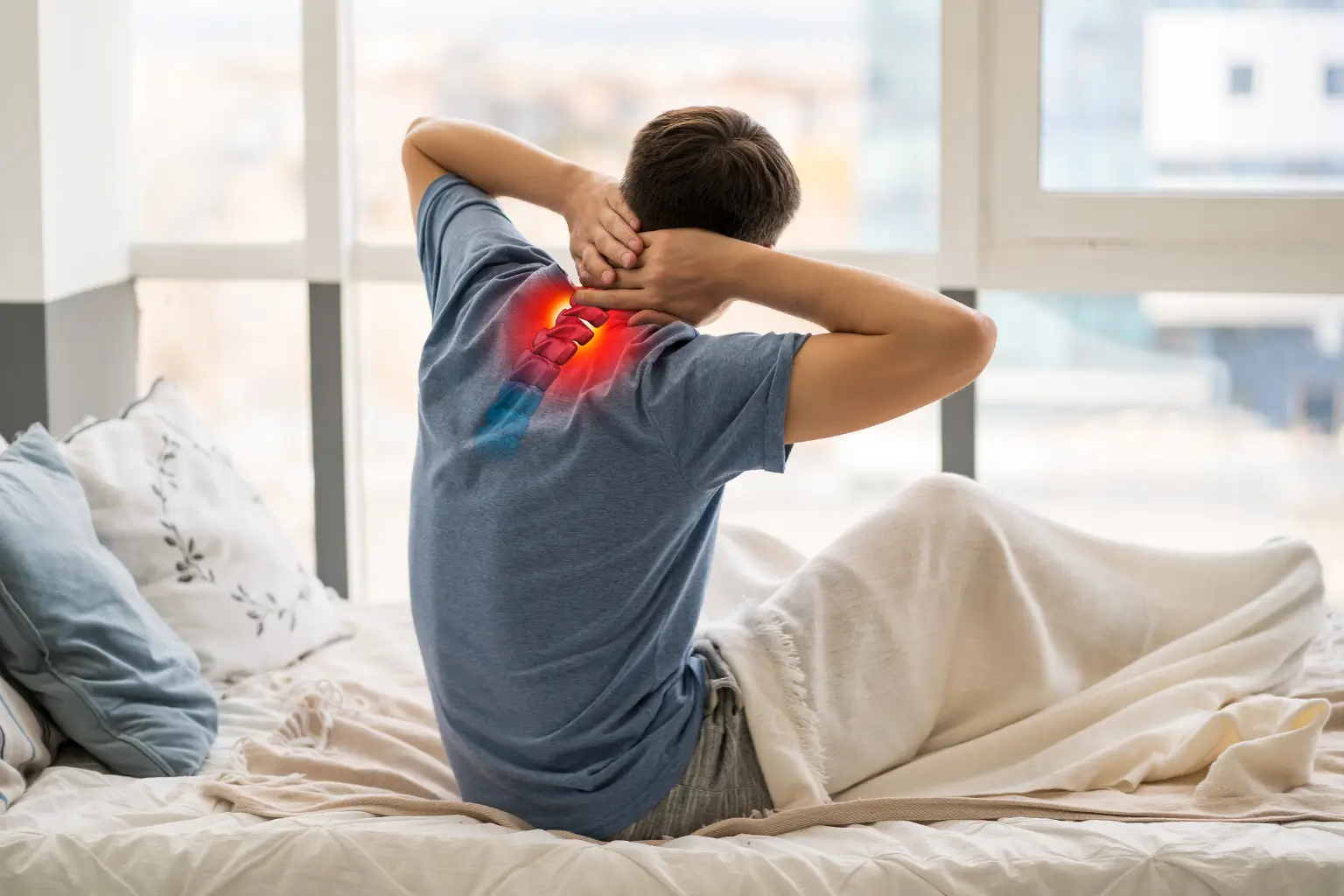
A patient-friendly guide to when cervical artificial disc replacement may be considered – and when another treatment may be safer.
Answer at a Glance
- You may be a candidate if one or two cervical discs are clearly causing nerve or spinal cord compression and your symptoms match your imaging.
- You are usually a better candidate when your spine has good motion, good alignment, healthy facet joints, and strong bone quality.
- You may not be a candidate if you have severe arthritis, spinal instability, osteoporosis, major deformity, infection, fracture, or a disc level that is already too stiff or collapsed.
Neck pain, arm pain, numbness, tingling, or weakness can be frustrating, especially when physical therapy, medications, injections, or time have not helped enough. For some patients, cervical disc replacement, also called cervical disc arthroplasty, may be an alternative to traditional neck fusion surgery.
The goal of cervical disc replacement is to remove a damaged or herniated disc in the neck, relieve pressure on the spinal cord or nerves, and place an artificial disc that helps preserve motion at that level. This makes it different from anterior cervical discectomy and fusion, or ACDF, which removes the disc and fuses the bones together.
So, Am I a Candidate?
You may be a candidate for cervical disc replacement if your symptoms are coming from one or two damaged discs in the cervical spine, usually between C3 and C7, and your imaging shows a disc problem such as a herniated disc, bone spur formation, or loss of disc height. Candidate selection usually depends on the combination of symptoms, neurologic findings, and imaging – not on MRI findings alone.
In practical terms, cervical disc replacement is most often considered when you have symptoms such as:
- Arm pain that travels from the neck into the shoulder, arm, or hand
- Numbness, tingling, or weakness caused by nerve compression
- Signs of spinal cord compression, such as balance problems, hand clumsiness, or worsening coordination
- Neck pain associated with a clearly identified disc problem
- Symptoms that have not improved after nonsurgical care, unless neurologic symptoms are progressing
Surgery is generally considered after conservative treatments such as medications, injections, and physical therapy have not provided enough relief. In some cases, surgery may be discussed sooner when weakness, spinal cord compression, or worsening neurologic symptoms are present.
What Makes Someone a Good Candidate?
A good candidate usually has a clear match between symptoms, physical exam findings, and imaging. That matters because cervical disc replacement is designed to treat pain or neurologic symptoms caused by a specific disc-level problem – not vague neck pain without a clear source.
Features that commonly support candidacy include:
- One or two symptomatic cervical disc levels
- Disc herniation, disc collapse, or bone spurs that compress a nerve or the spinal cord
- Preserved motion at the affected level
- Healthy or only mildly arthritic facet joints
- Good spinal alignment without major kyphosis or deformity
- No significant instability on flexion-extension X-rays
- Adequate bone quality to support the implant
Your surgeon will usually evaluate this with MRI, X-rays, and sometimes CT imaging, along with a neurologic exam to check strength, sensation, reflexes, balance, and signs of spinal cord compression.
When Cervical Disc Replacement May Not Be the Right Choice
You may not be a good candidate if the painful level is already too stiff, unstable, collapsed, or arthritic. Cervical disc replacement works best when the goal is to preserve motion, so it is less ideal when the spine has already lost healthy motion or when the joints in the back of the spine – the facet joints – are severely arthritic.
You may be steered toward fusion or another procedure if you have:
- Significant facet arthritis
- Osteoporosis or poor bone quality
- Spinal instability
- Severe deformity, scoliosis, or significant kyphosis
- Infection, tumor, or fracture
- Severe bony compression that cannot be adequately treated with disc replacement
- Allergy to implant materials, depending on the device
- Prior major surgery that changes the anatomy or stability of the neck
Recent reviews note that some traditional eligibility rules are being reconsidered. For example, carefully selected patients with mild segmental kyphosis, multilevel disease, or hybrid constructs may sometimes be considered. However, patients with major deformity, severe facet degeneration, or ossification patterns that require a different decompression strategy may still be better served with fusion or another approach.
What If I Have More Than One Bad Disc?
Historically, cervical disc replacement was used mainly for one-level disease, and some devices are approved for one level only. The field has evolved. Some devices are approved for two contiguous levels, and newer research has explored multilevel disc replacement and hybrid surgery, where one level receives a disc replacement and another level receives a fusion.
That does not mean everyone with multilevel degeneration should have multiple artificial discs. The decision is individualized. One level may be flexible and well suited for disc replacement, while another level may be too collapsed or arthritic and better suited for fusion.
Is Age a Dealbreaker?
Not necessarily. Many early cervical disc replacement studies focused on younger or middle-aged adults, but age alone is not always an automatic exclusion. The more important question is usually not simply how old am I, but rather: what is the condition of my bones, joints, alignment, and spinal motion?
Older patients may still be considered when the anatomy is favorable, but surgeons often look closely at bone density, facet arthritis, motion at the target level, and medical risk factors.
Why Choose Disc Replacement Instead of Fusion?
The main advantage of cervical disc replacement is motion preservation. Fusion can be an excellent operation, but it eliminates motion at the treated level. Disc replacement aims to maintain more normal motion while relieving nerve or spinal cord pressure.
Research comparing cervical disc replacement with ACDF has generally found that CDA can provide similar or sometimes better long-term outcomes in appropriately selected patients. Multiple reviews have reported lower reoperation rates and lower adjacent-level surgery rates with CDA compared with ACDF in selected groups.
Long-term studies have also reported preserved motion and lower adjacent segment degeneration after disc replacement compared with fusion, although results depend heavily on patient selection, surgical technique, and device design.
The best surgical approach depends on the specific condition, spinal anatomy, symptoms, and treatment goals, since different types of spine surgery are designed to address different structural problems.
What Are the Risks or Limitations?
Cervical disc replacement is not risk-free. Potential issues include swallowing difficulty, hoarseness, nerve injury, implant movement, implant wear, persistent pain, need for revision surgery, and bone-related complications.
One long-term concern is heterotopic ossification, which means extra bone forms around the artificial disc and may reduce motion over time. The source literature notes that heterotopic ossification remains a concern, particularly in some multilevel cases and certain device designs.
Another emerging topic is bone loss around cervical disc implants. Recent reviews describe this as an area with limited evidence to guide management and recommend close radiographic follow-up when bone loss is seen.
Does the Type of Artificial Disc Matter?
Yes. Artificial discs differ in how much motion they allow and how constrained they are. Device design may influence range of motion, adjacent-level stress, and reoperation risk. A recent network meta-analysis found that semiconstrained and unconstrained designs may offer advantages in adjacent segment protection and patient-reported outcomes compared with fusion in selected patients.
That does not mean one implant is best for every patient. The right disc depends on your anatomy, spinal alignment, bone quality, number of levels treated, surgeon experience, and the specific goals of surgery.
Questions to Ask Your Spine Surgeon
- Do my symptoms match the disc problem seen on my MRI or CT scan?
- Is my problem at one level, two levels, or more than two levels?
- Are my facet joints healthy enough for motion-preserving surgery?
- Do I have instability, kyphosis, osteoporosis, or severe arthritis that would make fusion safer?
- Am I a candidate for disc replacement, fusion, or a hybrid procedure?
- Which artificial disc would you use, and why?
- What are the risks of heterotopic ossification, implant wear, or future revision in my case?
- What results are realistic for my neck pain, arm pain, numbness, or weakness?
Bottom Line
You may be a candidate for cervical disc replacement if you have a clearly identified one- or two-level cervical disc problem causing nerve or spinal cord compression, your symptoms match your imaging, and your spine still has enough healthy motion, alignment, bone quality, and facet joint health to support an artificial disc.
You may not be a candidate if your spine is unstable, severely arthritic, significantly deformed, osteoporotic, infected, fractured, or already too stiff at the affected level.
The best way to know is to have your imaging and symptoms reviewed by a spine surgeon who performs both cervical disc replacement and fusion. The right operation is not simply the newest or most motion-preserving option – it is the one that best matches your anatomy, diagnosis, and long-term goals.
Educational Note
- This article is for general education and should not replace a medical evaluation.
- Seek urgent medical care for worsening weakness, loss of balance, loss of bowel or bladder control, or rapidly worsening neurologic symptoms.