
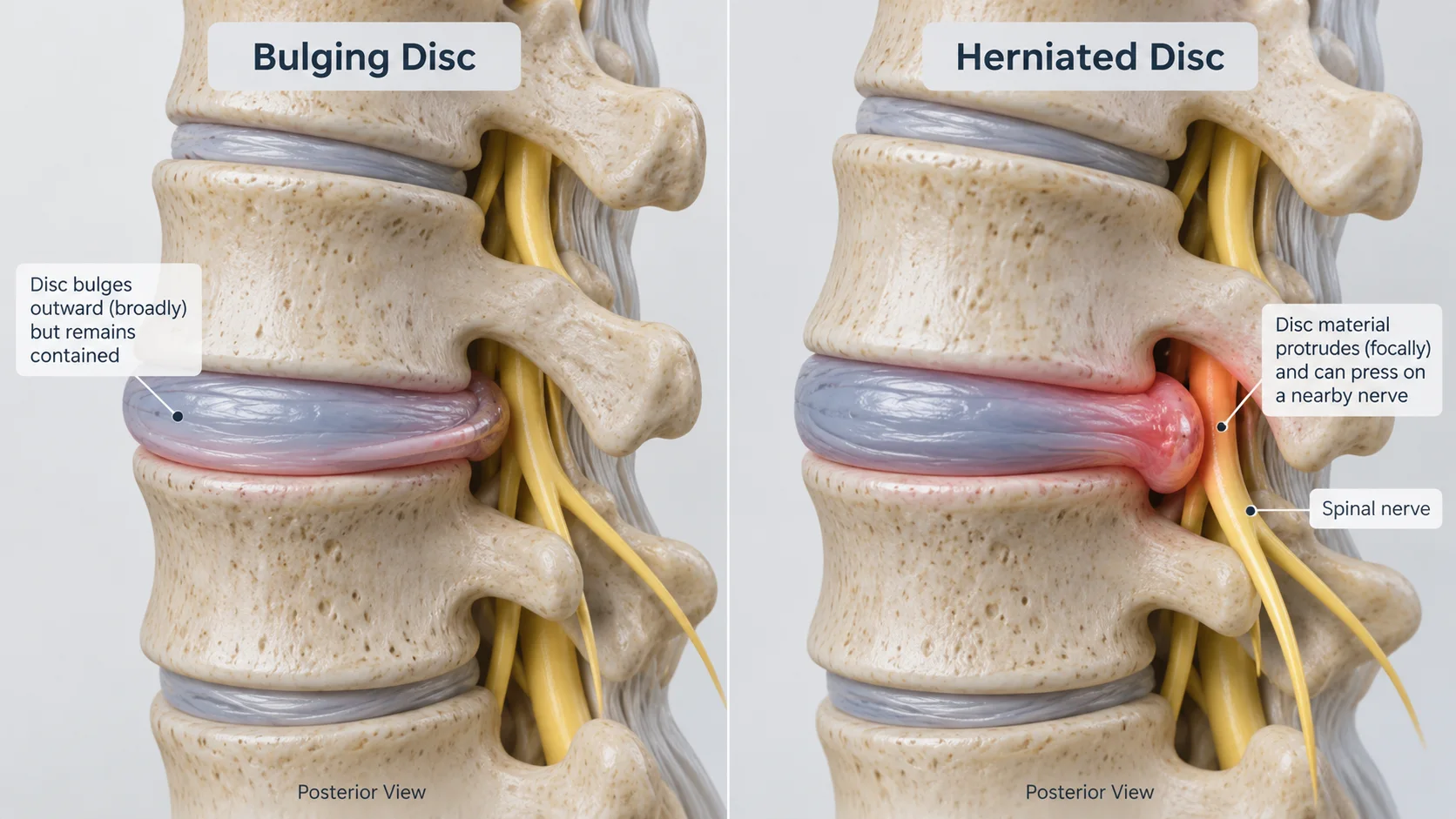
Yes, there is a difference – but it is mainly a difference in shape, not a simple measure of severity.
In standardized terminology for lumbar discs, a disc bulge is a broad extension of disc tissue beyond its usual boundary. A disc herniation is a more localized displacement of disc material. Either finding can cause symptoms, and either can appear on an MRI in someone who has no pain.
The most useful question is not, “Which label sounds worse?” It is, “Does this finding affect a nerve or the spinal cord in a way that matches my symptoms and neurologic examination?”
The Difference at a Glance
| MRI term | What it usually describes | Clinical takeaway |
|---|---|---|
| Bulging disc | Disc tissue extends broadly beyond the usual edge of the disc space. A bulge may be symmetric or asymmetric. | A broad bulge may be incidental or may narrow the spinal canal or a nerve opening. |
| Herniated disc | Disc material extends beyond the disc space in a localized area. | A focal herniation may be incidental or may affect a nearby nerve or the spinal cord. |
The formal consensus definitions were developed for lumbar discs. Similar words are commonly used in neck and other spine reports, but wording can vary.
Shape and Tissue Integrity Are Separate Questions
A spinal disc has a fibrous outer region, called the annulus fibrosus, around a softer central region, called the nucleus pulposus. “Bulge” describes a broad contour, while “herniation” describes localized displacement. Those shape terms do not establish that every outer fiber is intact or reveal when and why the change developed.
A report may separately mention an annular fissure, meaning a separation in the outer disc fibers. A fissure does not, by itself, prove a traumatic injury or identify the source of pain.
Protrusion, Extrusion, Sequestration, and Migration
If an MRI report calls a disc finding a herniation, it may describe its shape in more detail:
- Protrusion: In the same imaging plane, the displaced material outside the disc space is no wider than its base at the disc.
- Extrusion: In at least one imaging plane, the displaced material outside the disc space is wider than its base. An extrusion can still be connected to the original disc.
- Sequestration: An extruded fragment has completely separated from the disc it came from.
- Migration: Displaced disc material has moved away from its point of origin. It may or may not remain connected to the disc.
These terms describe the disc at the time of the scan, not a required sequence. A broad bulge and a focal herniation can appear at the same level.
Is a Herniated Disc More Serious Than a Bulging Disc?
Not necessarily. A focal herniation in an open area may cause no symptoms. A broad bulge in a tight spinal canal or nerve opening may contribute to significant compression.
Clinical importance depends on several details:
- Level, side, and location: Does the finding correspond to the painful, numb, or weak area?
- Effect on nearby structures: Does the report describe contact, displacement, or compression of a nerve root or the spinal cord?
- Symptoms and examination: Do pain, sensation, strength, reflexes, balance, and walking point to the same nerve or spinal level?
- Change over time: Are symptoms improving, stable, or worsening? Is strength or function declining?
- Other findings: Arthritis, stenosis, instability, or a non-spine condition may also explain symptoms.
Treatment decisions require this full clinical picture, not a measurement or MRI term alone.
Symptoms Depend on What the Disc Affects
A disc finding may cause local neck or back pain, but symptoms traveling into an arm or leg more often suggest that a nerve root is irritated or compressed.
In the lower back, nerve-root symptoms may include pain that travels through the buttock and leg, numbness or tingling in part of the leg or foot, or weakness such as difficulty lifting the front of the foot. This pattern is often called lumbar radiculopathy or sciatica.
In the neck, a compressed nerve root may cause pain, tingling, numbness, or weakness in the shoulder, arm, hand, or fingers. This is cervical radiculopathy.
A cervical disc can also affect the spinal cord rather than only one nerve root. Loss of hand coordination, increasing trouble with buttons or writing, worsening balance, an unsteady walk, or weakness involving the arms or legs may point to cervical myelopathy. That pattern needs urgent clinical assessment rather than a routine appointment.
How a Spine Specialist Interprets the MRI
MRI usually gives the clearest view of discs, nerve roots, and the spinal cord. Plain X-rays show bones and alignment but do not directly show a disc bulge or herniation. CT or CT myelography may be used when MRI is not possible or when more detail about bone or the spinal canal is needed.
The report is only one part of the evaluation. A clinician reviews the actual images, maps the symptoms, and checks strength, sensation, reflexes, coordination, balance, and walking. The clinician then determines whether the findings converge on the same nerve or spinal cord level. Disc changes are common in people without pain: some findings explain symptoms, while others do not or contribute alongside another problem.
Does the MRI Label Change Treatment?
Usually, the label alone does not.
A bulge or herniation without matching symptoms or neurologic findings usually does not need a procedure. Cervical spinal cord compression still deserves clinician review even when obvious symptoms are absent.
For stable nerve-root symptoms without signs of fracture, infection, cancer-related compression, spinal cord dysfunction, or cauda equina syndrome, care often begins with activity as tolerated, individualized physical therapy, and medication when medically appropriate. These options may reduce symptoms and improve function.
Suspected cauda equina syndrome requires immediate emergency assessment. Significant or progressive weakness and signs of cervical myelopathy also change the timetable and require urgent specialist assessment.
Surgery may be discussed when disabling arm or leg symptoms continue despite appropriate nonsurgical care and the examination and imaging identify the same compressed nerve. Timing may be earlier when muscle weakness is major or worsening.
For selected lumbar herniations, microdiscectomy removes disc material pressing on a nerve. Fusion is not routine for an isolated first-time lumbar herniation. Cervical procedures differ depending on whether the problem affects a nerve root, the spinal cord, or both.
When to Seek Emergency Care
Call 911 immediately for:
- Sudden weakness or numbness of the face, arm, or leg—especially on one side—or facial drooping, trouble speaking, vision changes, or sudden loss of balance. These may be stroke signs, even if they improve or go away.
- Sudden or rapidly worsening weakness in an arm or leg, or a new inability to stand or walk.
- New weakness, numbness, inability to move normally, or trouble breathing after a major neck or back injury. Keep the person still unless the surroundings are unsafe.
Go to the emergency room now, and call 911 if you cannot travel safely, for:
- New inability to urinate, loss of the normal urge or sensation to urinate, or new loss of bladder control
- New loss of bowel control or sensation when passing stool
- New numbness around the genitals, anus, buttocks, or inner thighs—the “saddle” area
- New loss or marked change in sexual sensation or function with back or leg symptoms
- New or rapidly worsening symptoms in both legs, especially weakness or numbness
- Severe neck or back pain after a significant fall, collision, or other major injury
- Current or past cancer together with new radiating arm or leg pain, weakness, numbness, trouble walking, or bladder or bowel changes
- Fever or signs of serious illness with new weakness, confusion, bladder or bowel changes, or rapidly worsening spinal pain
These symptoms may signal cauda equina syndrome—a compression of lower-spine nerves that help control the legs, bladder, bowel, and saddle area—spinal cord compression or injury, stroke, or another neurologic emergency. De Novo Brain & Spine is an outpatient practice and does not provide emergency care. Do not wait for an office appointment.
When to Arrange a Prompt Evaluation
Seek same-day medical advice for new foot drop or other new muscle weakness; worsening hand dexterity; a gradual decline in balance or walking; or numbness or weakness that is spreading. Sudden, rapid, or severe changes belong in the emergency section above.
Same-day assessment is also appropriate for new or worsening spinal pain with fever, chills, recent serious infection, immune suppression, injection drug use, or a recent spinal procedure. A person with current or past cancer should seek urgent advice for new severe or progressive spine pain or pain at night, even without weakness.
Persistent pain that limits normal activity or does not improve deserves evaluation. Pain alone is usually not an emergency when none of the warning signs above are present.
Questions Patients Often Ask
Can a bulging disc turn into a herniated disc?
A disc can change over time, but a bulge is not a required first stage of herniation and does not predictably progress into one. A broad bulge and focal herniation may also coexist.
Why might two MRI reports use different terms?
The criteria are standardized, but radiologists may describe borderline shapes differently or emphasize different details. Comparing the actual images, not only the wording, helps clarify whether a meaningful change occurred.
What should I bring for a second opinion on an MRI?
Bring the actual MRI images if possible, not only the written report, along with any older spine studies and a list of treatments you have tried. Note where symptoms travel, when they began, whether they are changing, and any loss of strength or function.
Get Clarity About Your MRI Findings
If your report uses terms such as bulge, protrusion, extrusion, or sequestration, the useful question is how the images relate to your symptoms and neurologic function.
At De Novo Brain & Spine in Stockbridge, care is led by a spine surgeon and serves adults from South Metro Atlanta and nearby communities. Larry R. Shannon II, MD, FAANS, is a board-certified neurosurgeon and spine surgeon involved in evaluation and treatment planning. For a second opinion, call (404) 882-3592 or request a second opinion online.
This article is for general educational purposes and does not replace an in-person medical evaluation. If you may be experiencing an emergency, call 911 or go to the nearest emergency room.